

Control Coverage (Pro)
The control coverage view answers a simple question: which 800-53 controls do my scanners actually test, and where are the open weaknesses per control?
Where mappings come from
Many scanners already emit control references, and DefectDojo extracts them into control mappings automatically. Among others:
- Prowler writes NIST 800-53 control lists into finding references.
- Tenable plugins carry 800-53 cross-references.
- InSpec and MITRE SAF profiles tag their checks with
nistidentifiers.
Extraction is grounded in the imported catalog, so an identifier the catalog does not recognize never produces a mapping.
Findings that carry no control references of their own are attributed to the default scan controls on the Compliance Profile — see Compliance Profile.
DISA STIG checklists, through their CCIs
A STIG rule does not name an 800-53 control. It cites one or more CCIs (Control Correlation
Identifiers), which is DISA’s own index into the control catalog — CCI-000366, for example, is
the configuration-settings CCI and resolves to CM-6.
DefectDojo crosswalks those CCIs to their controls using DISA’s published CCI list, so importing a checklist populates control coverage with no extra configuration. See DISA STIG Checklists for the import itself.
The crosswalk covers the NIST 800-53 Rev 5 references DISA publishes, and like reference extraction it is grounded in the imported catalog. Checklists assessed against a control set the bundled catalog does not cover produce no mappings rather than approximate ones.
When two sources disagree
A finding can pick up a control mapping from more than one source. Where they disagree, the more authoritative one wins, in this order:
- A mapping you set by hand.
- A CCI crosswalk from a STIG checklist.
- A control reference extracted from the finding’s own text.
- The profile’s default scan controls.
A CCI crosswalk outranks text extraction because the CCI is published by the same authority that wrote the checklist, where an extracted reference is read out of free-form scanner output.
Backfilling existing findings
Mapping runs as findings arrive. To map findings that were already imported before the feature was enabled, backfill them:
manage.py extract_control_mappings --product <id>Use --all to scan every active finding instead of one Asset. Both passes — reference
extraction and the CCI crosswalk — run by default; --skip-scanner-refs and --skip-crosswalk
run one without the other. The command reports how many mappings each pass created, and it leaves
manual and suppressed mappings alone.
Re-running it is safe: a mapping that is already correct is left untouched.
Correcting a mapping
Mappings you create or correct by hand always win over extracted ones, and a mapping you delete stays deleted — re-imports will not resurrect it.
What the view shows
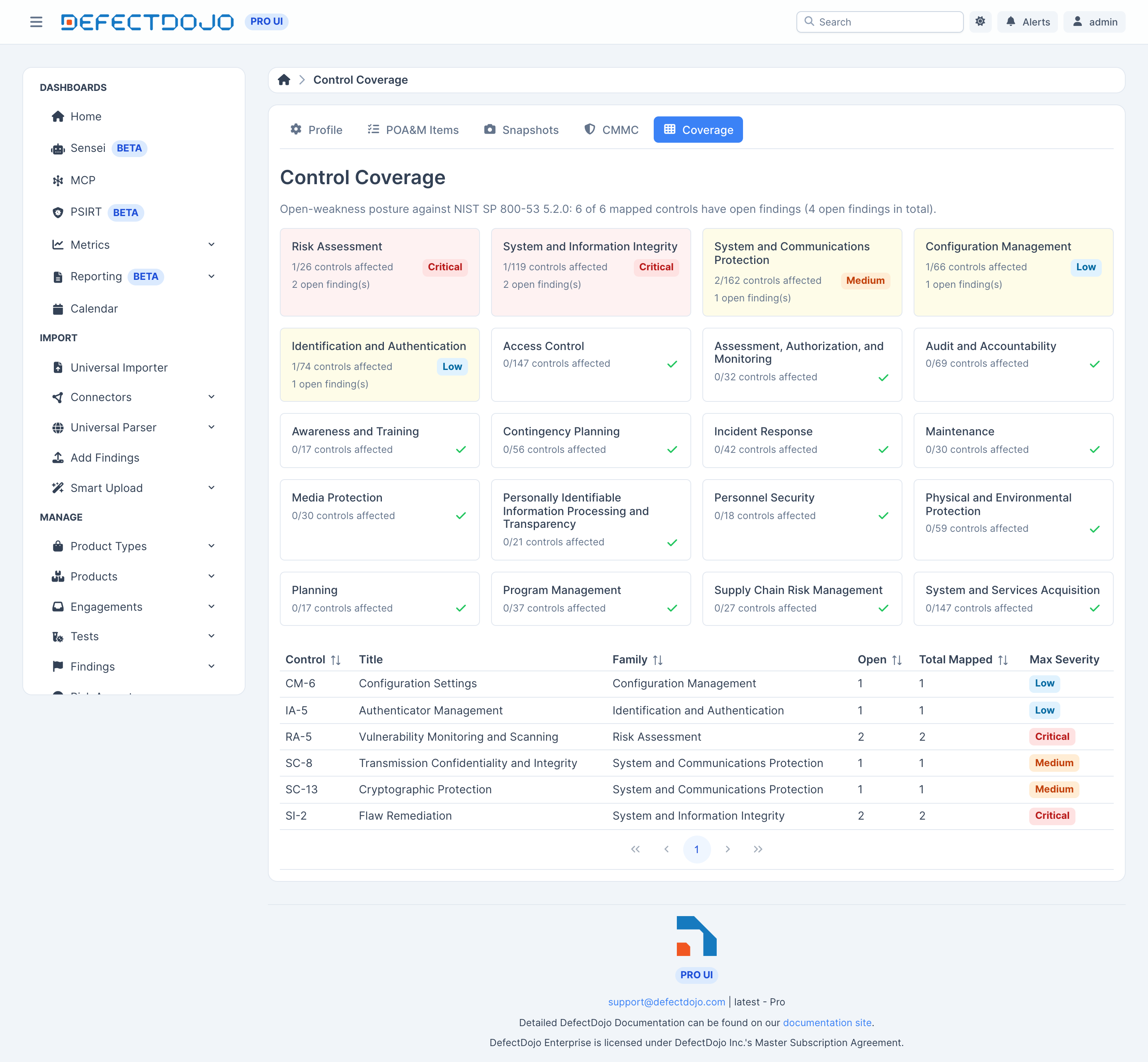
- A heatmap by control family.
- Per control, the open findings mapped to it.
Controls come from the bundled catalogs: NIST 800-53 Rev 5 and NIST 800-171 Rev 2, both imported on startup.
Coverage is advisory while the feature is in beta. Control coverage reflects what your scanners report and what the bundled catalogs recognize. It is not an attestation that a control is implemented or effective. Confirm coverage against your System Security Plan before relying on it for an assessment.
Auditability
Control mappings are under audit history. Every change records who, what, and when.